
Project – Monument to the Fallen of All Wars – Pastena (SA)
Theoretical Approach to the Project
War memorials are often associated with heavy, monolithic sculptures that—rather than evoking the spirituality or the memory of the victims of war’s horrors—seem to assert a presence of earthiness through the hardness and permanence of materials like marble, stone, or bronze.
In contrast, this specific project—while utilizing a striking architectural structure (a truncated pyramid made of lava stone and glass)—aims to exalt the spiritual weight (rather than material mass) of such a monument. It does so through light, an emphasis on lightness, and the search for meaning, ultimately stripping away all superfluous geometry or volumes in favor of an essential yet richly nuanced intervention.
Technical Description of the Architecture
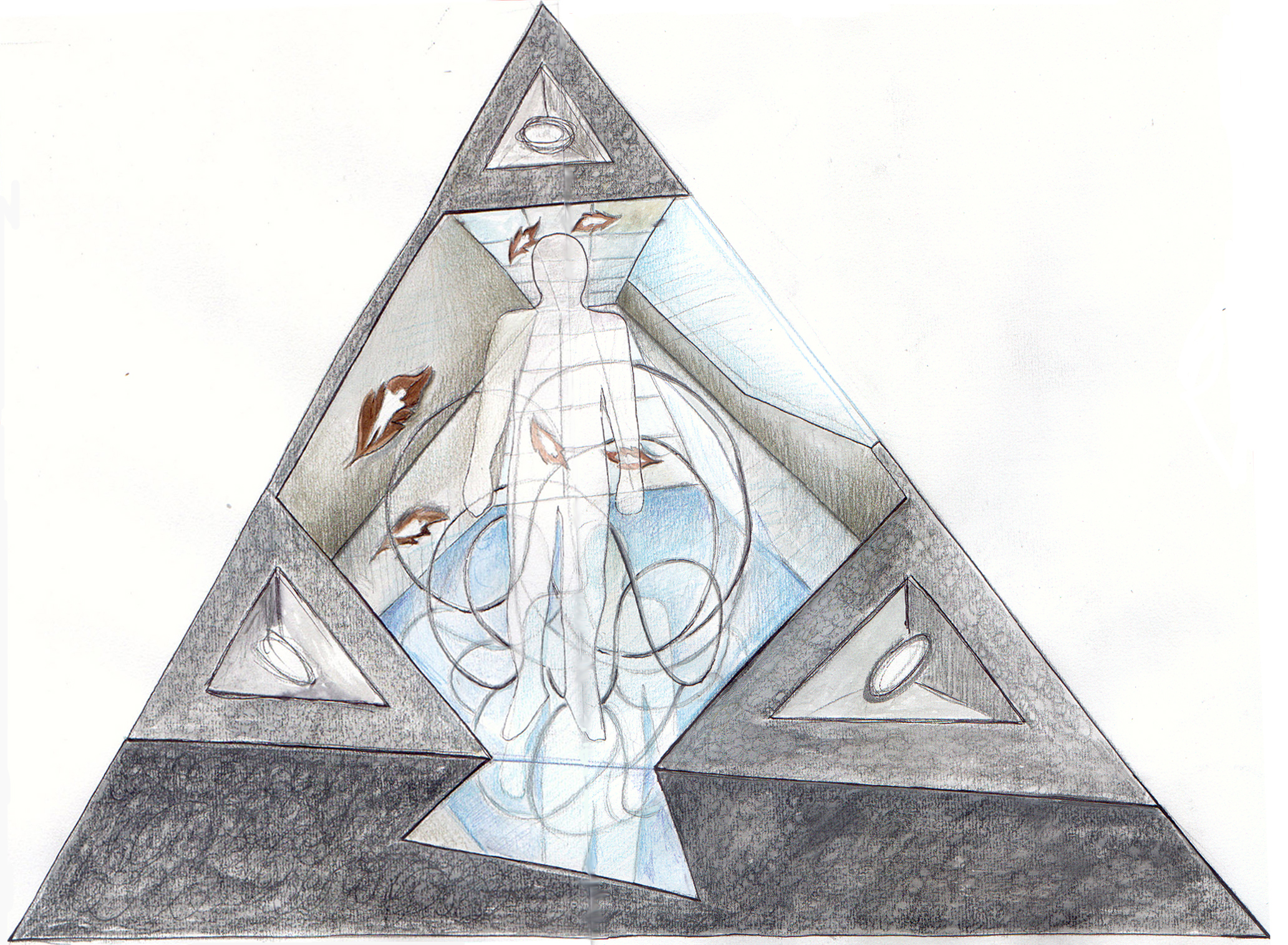
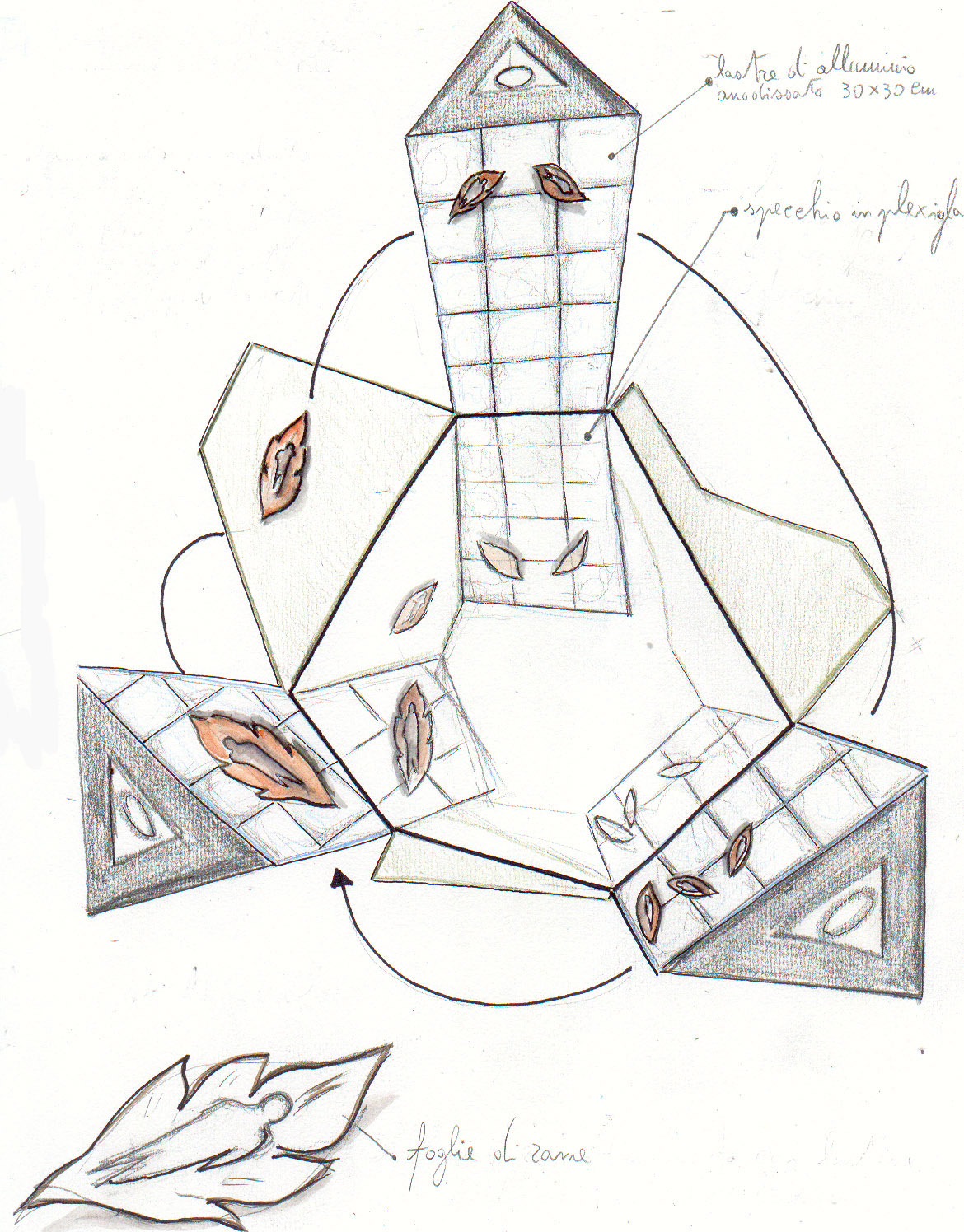
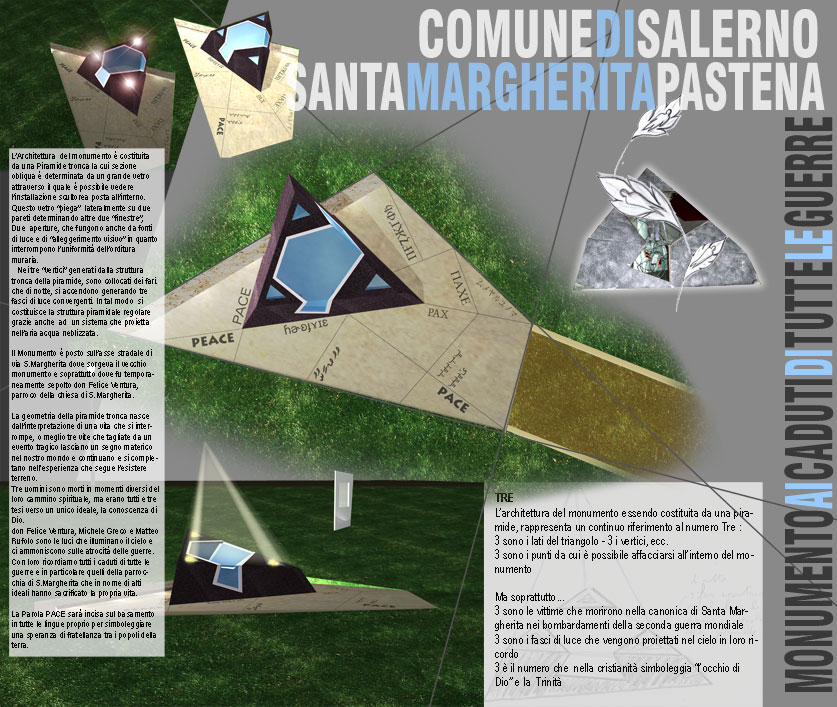
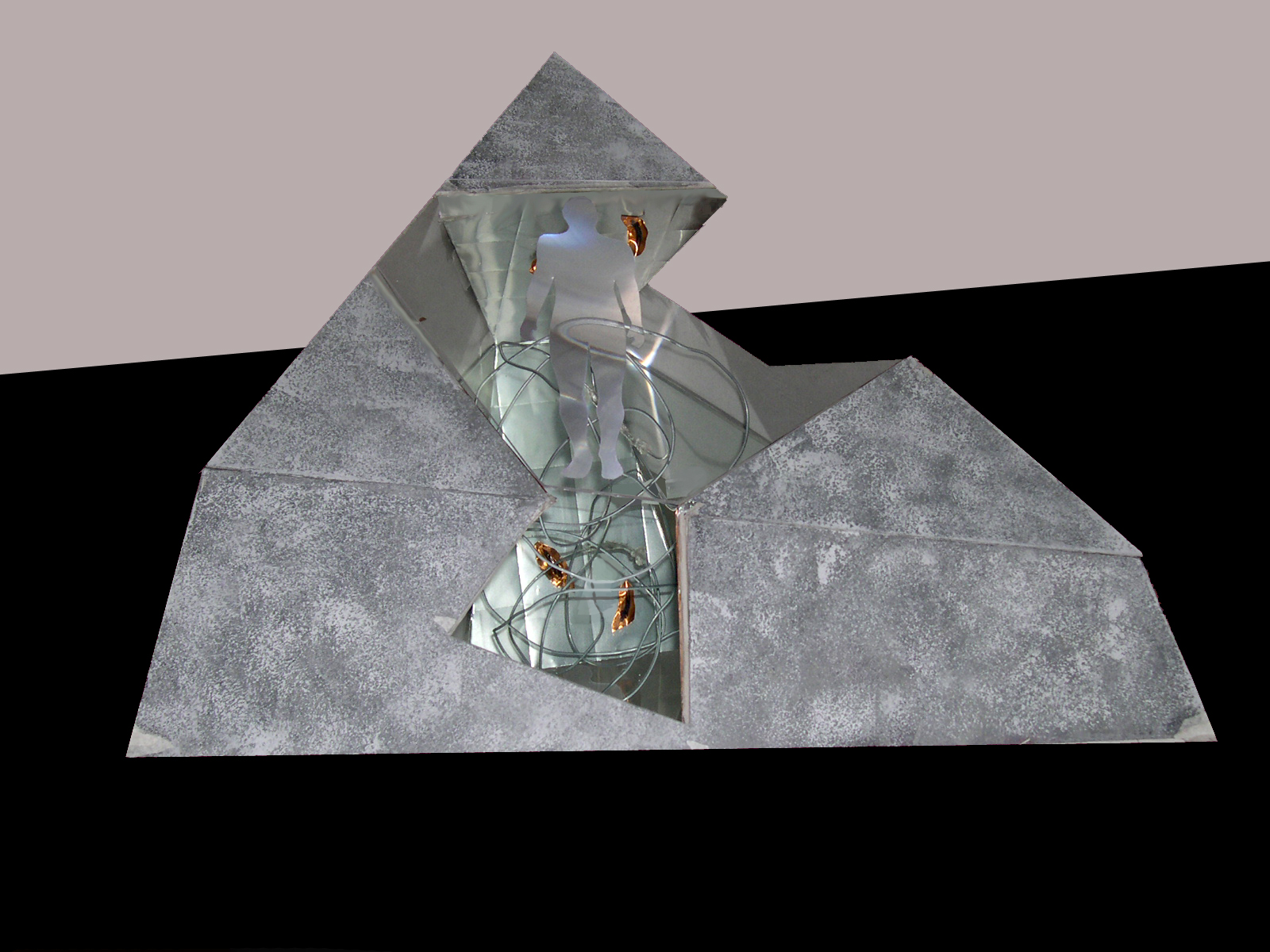
The monument's architecture consists of a truncated pyramid, whose slanted face is a large pane of glass through which the internal sculptural installation is visible. This glass panel wraps across two adjacent facades, forming two additional “windows.” These openings act both as viewpoints inward—framing the inner structure—and as sources of light and visual relief, breaking the uniformity of the masonry.
The monument’s base is deceptively “breached” by a large mirrored plexiglass panel that reflects the blue of the sky into the architecture, expanding its perceived volume.
At the very center of this base—essentially on the mirror of sky—stands a stylized globe made from a single copper tube (filled, painted), coiled like a massive ball of yarn. This structure’s image doubles through its reflection in the mirror beneath it, visually amplifying its presence.
On the pyramid’s glass top, centrally positioned, lies a large silhouette of a human figure, constructed from magnifying lenses on plastic sheets (or alternatively sandblasted into the glass). While the figure remains subtle, it catches and refracts sunlight both inside and outside of the structure, duplicating—via mirror reflection—the image of a being made of light, expanding perspective dramatically.
At the three "vertices" of the truncated pyramid, spotlights are installed. At night, they cast three beams of light that converge at a single point, effectively reconstructing the geometry of the pyramid through both physical light and nebulized water projected into the air—creating a luminous, geometric form floating above.
The Symbols
The pyramid shape continuously references the number three:
Three sides of the triangular base, three vertices.
Three viewing points from which one can peer into the monument.
Most poignantly: three are the victims who perished in the church of Pastena during World War II bombings.
Three are the beams of light projected into the sky in their memory.
In Christian symbolism, the number three evokes the Eye of God and the Trinity.
The Human Figure
The figure—both victim and executioner of war—sees its silhouette reflected in the large mirror inside the monument, thus contemplating itself, or perhaps another, figure of light, projected heavenward. Inside the structure lies a distorted world, coiled like a great ball of yarn, through which reflected “leaf-like” images appear—each leaf imprinted with a human figure.
Leaves, symbols of Life and Ephemerality, metaphorically circle the globe—echoing the cycle of life. Though the Leaf (and thus Humanity) may die in a “terrestrial” sense, its “flight” (soul, spirit) always ascends to the heavens, toward Light, regardless of vantage point.
This work intends not only to memorialize the fallen of all wars but also—as inscribed on its marble base—to stand as a symbol of Peace and Hope. The individual who gazes within sees themselves reflected in the mirror—protagonist in this metaphor of life—an exhortation not to repeat the atrocities of war in the future.
The Light
Light has always symbolized God, serenity, and hope. It is the monument’s principal element, manifesting differently throughout the day.
By day, the mirrored base projects the sky’s colors into the sculpture’s interior, creating an impression of openness within an otherwise confined space. The human figure sees in the Light a sign of hope, a possibility of salvation.
By night, three beams of light ascend into the heavens, their paths drawn through air and fine mist—forming the “regular pyramid” shape with pure light. This geometric form of light becomes the essence of remembrance—a vivid presence in the spirit rather than the material.