

O di Otranto
Installation – 300 x 200 cm
Year: 2002
Materials: wood, terracotta, wool, galvanized wire, acetate sheets, print
Materials: wood, terracotta, wool, galvanized wire, acetate sheets, print
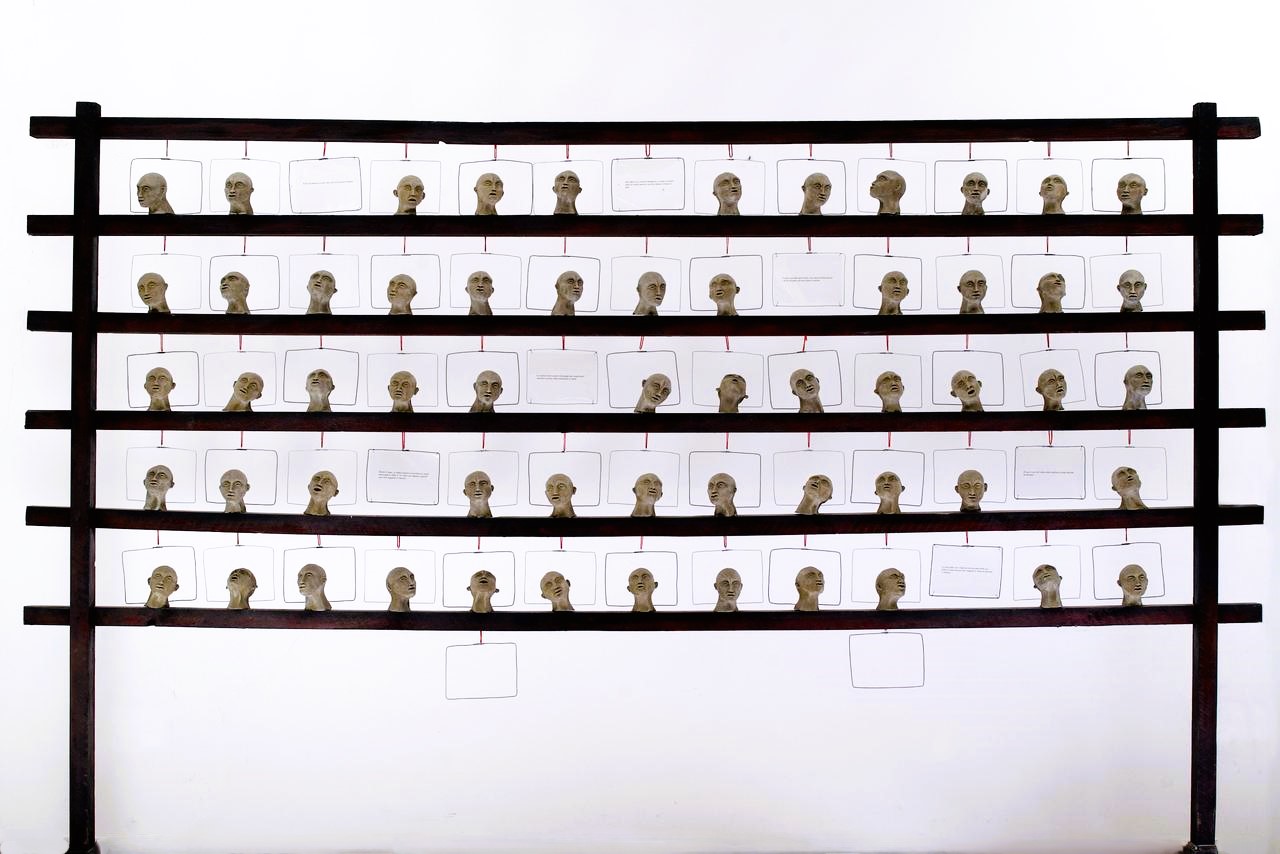
O di Otranto is an installation created in the early 2000s, in response to the first reports of migrant landings on the Salento coast, near the town of Otranto.
At the time, the phenomenon of “boats” carrying migrants had not yet become widespread, and the image of bodies crowded onto fragile vessels in search of a better life caused a powerful emotional reaction.
At the time, the phenomenon of “boats” carrying migrants had not yet become widespread, and the image of bodies crowded onto fragile vessels in search of a better life caused a powerful emotional reaction.
O di Otranto speaks of migration, wandering, and those perpetual flows—across space or within the mind—tied to the pursuit of a “better condition,” whether physical or internal, real or imagined.
The work is dedicated to all those who "flee," clinging to the hope of finding refuge—which all too often turns out to be nothing more than a suspended port.
Though grounded in a reflection on the present, the installation draws inspiration from an ancient Shinto ritual: a wooden structure resembling a musical score, where votive tablets and scrolls are hung using red threads, left to sway in the wind.
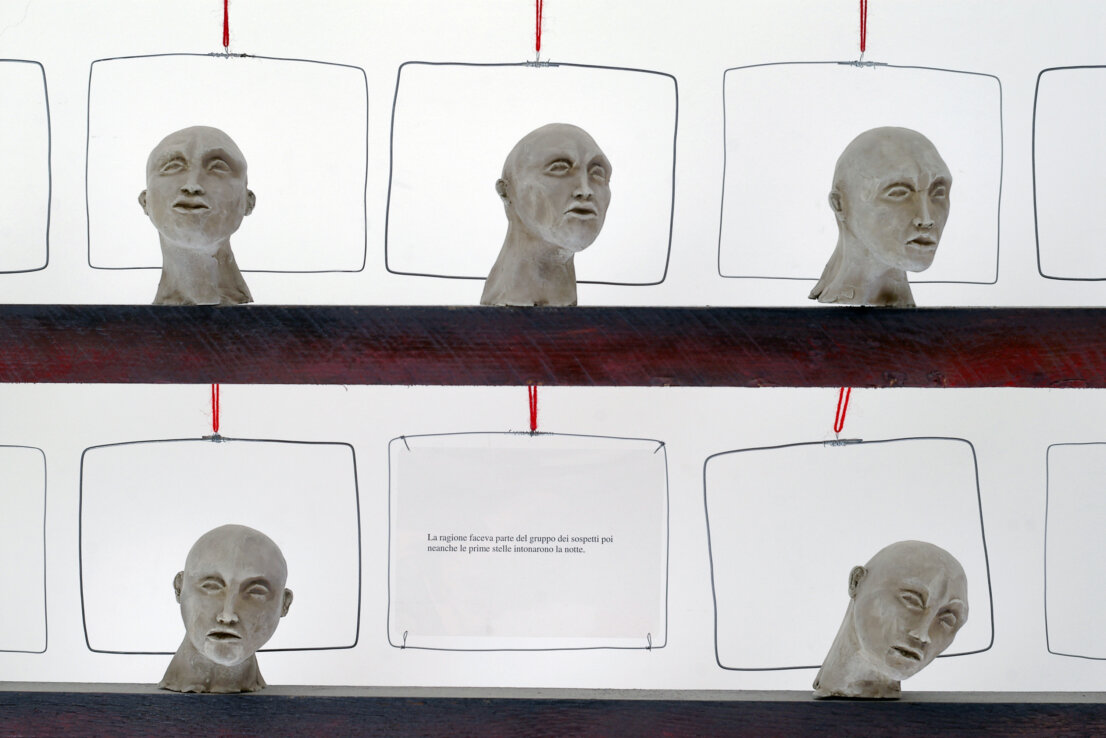
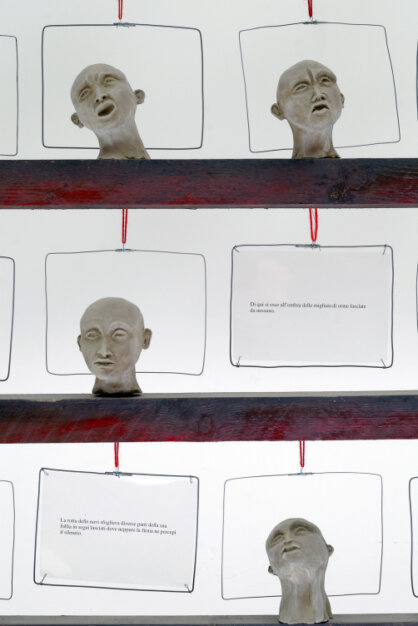
In O di Otranto, the scrolls are replaced by 58 sculpted faces—similar, yet each one unique—framed within rectangular wire structures reminiscent of traditional prayer tablets.
Where faces are missing, handwritten messages appear: seven surreal phrases that can be read in any order, leaving visitors free to create their own interpretative path.
Where faces are missing, handwritten messages appear: seven surreal phrases that can be read in any order, leaving visitors free to create their own interpretative path.
O di Otranto thus becomes a place of memory and suspension, a secular altar dedicated to the dignity of the journey, of hope, and of the human search for an “elsewhere.”
.
O di Otranto
O of Otranto
Tribù di piume percosse alla corte di un porto sospeso.
Tribes of beaten feathers at the court of a suspended port.
Sull'albero dei concetti inespressi , al vento si levano radici di inutili pensieri in esilio dipinti in bianco e nero.
On the tree of unspoken concepts, roots rise in the wind—exiled thoughts painted in black and white.
Il vuoto episodio quasi muto racconta di nobili pietosi e di un brigante nascosto dietro le parole.
The empty, almost mute episode speaks of pitiful nobles and a bandit hiding behind words.
La ragione faceva parte del gruppo dei sospetti poi neanche le prime stelle intonarono la notte.
Reason was among the group of suspects, then not even the first stars sang the night.
Dentro il mare la sabbia traslocò in un bosco di punti interrogativi. Oltre il "là" delle sue imprese " guardò" una voce suggerirle il silenzio.
Within the sea, the sand moved into a forest of question marks. Beyond the "there" of her deeds, a voice “looked” at her, whispering silence.
Di qui si esce all'ombra delle migliaia di orme lasciate da nessuno.
From here, one exits in the shadow of thousands of footprints left by no one.
La rotta delle navi sfogliava diverse parti della sua follia in segni lasciati dove neppure la firma ne percepì il silenzio.
The route of the ships leafed through various parts of her madness—signs left where not even the signature sensed the silence.